
fotobok
– Craft is a kind of activism against the forces of digital bullshit.
11/13/2026
Stikkord:
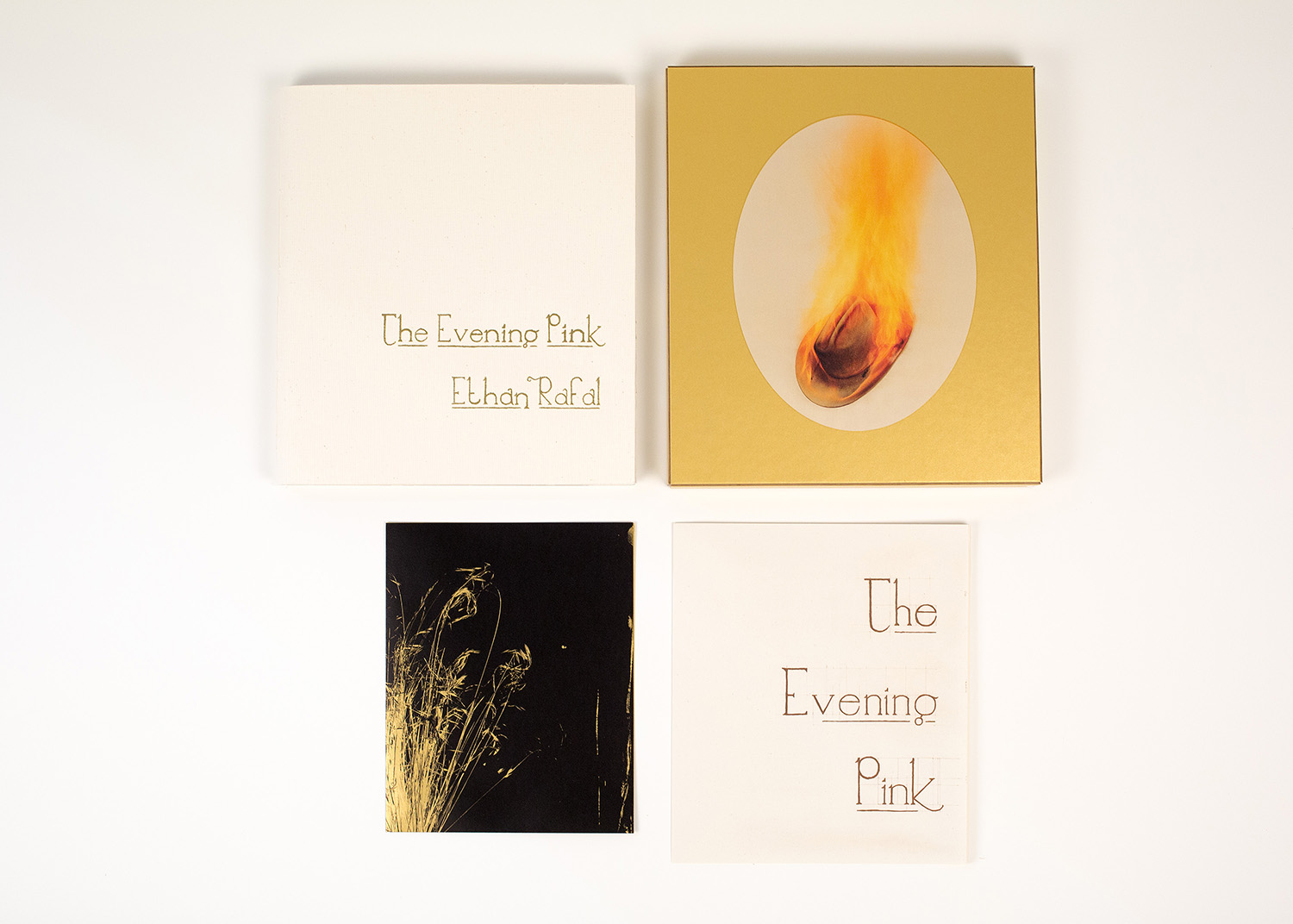
This fall, you published a photo book that sums up 15 years of work on your project The Evening Pink. Would you start by telling us briefly about this project and how it began?
The Evening Pink is an acid-Western, or more importantly, an anti-Western, photographed at the twilight of climate fallout. But, as with most projects I’ve worked on, its beginnings were defined by intuition and interest rather than any explicit understanding of what I was doing. The project is built from photographs, hand-made books, and film-based works created in the American West.
The project began in 2011, which is a long time ago. It’s difficult to describe this period: fifteen years isn’t quite history yet, but it’s also no longer entirely within the terrain of memory. Most people I knew had flip phones; I was considered a “total sellout” for having an iPhone.
During those early years of the Obama era, it was easy for some to walk around glazed over, in a kind of haze: 2001-2011 was a traumatic period in American history, it seemed that many wanted nothing more than to turn the page. But the 2008 financial crash had devastated my community, and I remember feeling that our generation was completely severed from those who came before us. We knew we would remain poorer than our parents, the wars were cannibalizing your friend group, and on top of this you were confronted with the apathy of older generations who should have been in the streets. And of course there was also the very real fear of total collapse via climate fallout. This was a distinct moment in time: you no longer sounded crazy when you said that the end of the world was coming. But the dominant liberal culture of the Obama era somehow produced so much inaction. Back in this early period of the project, my collaborators and I began to feel that a period of climate destruction was approaching, and that we should start making art and photographs in wilderness places we cared deeply about.
I was living in California, where the impacts of the mega-drought were becoming increasingly apparent. We had also witnessed the destruction of New Orleans in 2005. During this period, I worked on farms and as a commercial fisherman in Alaska, experiences that kept me close to the land. The changes were visible everywhere. It was increasingly clear that we were moving rapidly toward an unlivable future.
Oddly enough, in a certain way 2011 was a lot like 2026—the climate emergency was off the front page, people gladly ignored reports about the climate breaking down. There were important differences from 2026: this was before Greta Thunberg. The fires were still off in the foothills — coming. A sense of vertigo lingered. Anxiety. And back then we had the tech companies pouring money into saving the planet. Nobody could have known that 15 years later we would end up with this tech-oil-and-gas Frankenstein.
It is important to note that in this early period I had no idea I was making a Western, nor did I have any particular connection to the genre. That understanding emerged through the process, specifically in 2015, when I found the Mickey film while exploring in New Mexico with friends who had gone looking for a better life off the grid. This was a familiar West Coast tradition. The culture behind this project has roots in the anti-war and environmental movements of the 1960s and ’70s.

While working on the book, you experimented with analog processes such as exposing large-format film to rain, hail, and harsh light. Can you tell us more about how you worked photographically while making the images in the book?
Rain, hail, harsh light, smoke, extreme heat—you name it. You’d be surprised how resilient film is, and how much less sensitive it is than the average photo forum conversation would have you believe. I pushed it as far as taking a 4x5 camera into the ocean, which was how I rusted the shutter blades together and stopped using shutter speeds entirely.
I worked with old American 4x5, 5x7, and 8x10 cameras throughout the project. Over time, I began to think of the cameras as defining architectural space. It’s difficult to explain, but large-format photographers will know what I mean. I'm referring to the inner space of the camera itself. Because this is a physical space — large enough, perhaps, for a guinea pig in a 4x5 and a cat in an 8x10 — it began to feel like a world in its own right. I started imagining that space as a kind of laboratory, a place to model and re-examine the forces playing out in the world around us.
I don’t want to overstate the role of these experiments in the resulting prints. The positive transfer printing process, which I developed using my own chemistry, is also responsive to local climate conditions, and equally important in shaping the final work. No print can ever be replicated. The entire process, rather than any single technique, was immensely important to me.
I also want to emphasize how influential the artistic community around me in California was. Many of the artists I encountered in San Francisco were deeply committed to process: process-based and material abstraction, as well as inventing new cameras and printing techniques. This was where the culture saw a distinction between straight photography and art photography.
At the time, San Francisco was overflowing with new ways of thinking about and making photographs, from the digital image and Instagram — which was invented just down the road from my house — to the very physical, medium-driven work of artists like John Chiara, Chris McCaw, Klea McKenna, and Meghann Riepenhoff, to name a few. I cannot overstate how influential these artists were on my thinking and consciousness. And more than these individuals was a culture that was just excited to explore the edge of known terrain. Some of these artists have since become well known in Europe, and I’m beginning to see younger artists here influenced by their work. Still, I feel their contribution deserves much greater recognition.
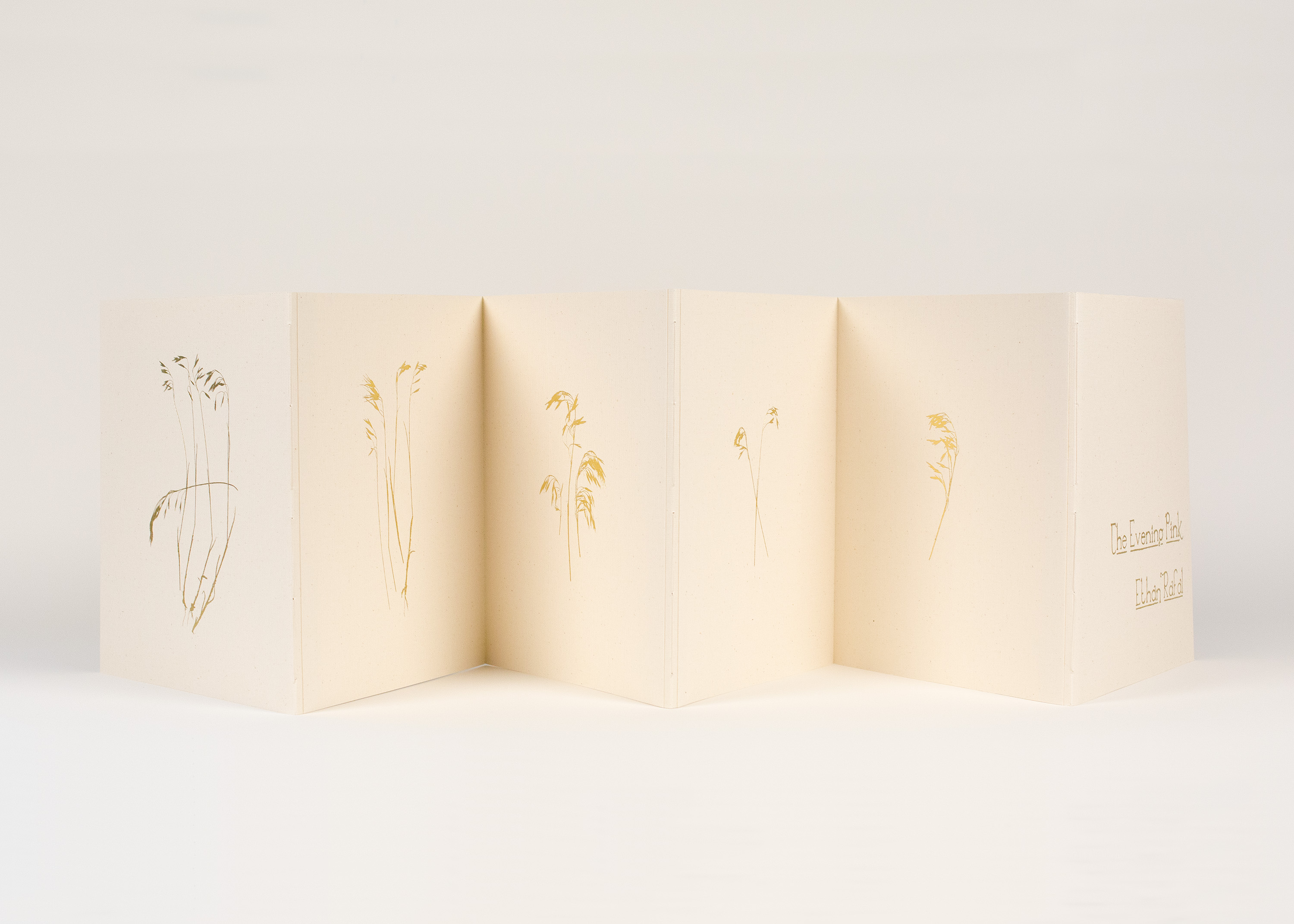
The book is meticulously handmade and presented in a clamshell box. What was the production process for the book like, and what made you decide to make it by hand?
Golly, where do I begin? I’ve always made handmade books, and over 25 years this has evolved into a complete practice: I sell handmade books and exhibit them as artworks.
This particular book grew out of frustration with the limitations of commercial printing and binding, and a desire to bridge the American artists’ book tradition with the European photobook. I want to be clear that the artists’ book tradition is not the same as the art book. The explosive growth of Art book fairs, from the NYABF and LAABF to their many imitators, including Kunstbok Oslo, has brought the wider art world’s habits and shortcomings into the book world. What interests me about the artists’ book tradition is the history of craft, and the extreme dedication to craftsmanship.
I invented the binding for this book. On a screen, it may resemble a leporello, but it is actually composed of many distinct pieces, each with a different weight that contributes to the total feel, and function of the book: flat, freestanding, or as an object in your hand. It took four years of testing to get right. This kind of undertaking requires an almost unreasonable dedication to the book as an art form. Or perhaps you simply have to be insane?
Translating the handmade book tradition, involving editions of perhaps ten copies, into a larger production was an enormous undertaking. Several production attempts collapsed along the way, due to partners going bankrupt and catastrophic price increases following COVID and the war in Ukraine. I went through three distinct phases of fundraising.
Ultimately, seven major partners were involved: two printers, two binders, two box makers, and a specialist foil-stamping craftsperson. Nearly everyone was at the veteran stage of their career. I tried calculating their combined years of experience, but gave up after 200. It was probably closer to 250 years. This book was only possible because of that accumulated expertise, and I doubt it could be made this way again. Some collaborators have already retired; others took it on as one last hurrah.
Several people told me I was crazy. It wasn't always easy, but there was an extraordinary collective enthusiasm to the project. The ghost of William Morris hovered over the entire process. In some way, we were resisting the culture of extreme mediocrity that prevails in the Western world now, the so-called Ai-infused slop. The cultural output in recent times just doesn’t interest me, I assume we are in a kind of 1980’s dead-zone.
Craft is a kind of activism against the forces of digital bullshit. Everyone complains about the conditions of 21st-century life, yet continues re-producing the culture, and participating in culture according to the same predefined models. I gambled everything on this book in an attempt to break that pattern, however modest a book is, and if only for myself. But the response so far suggests I’ve hit a nerve.

You describe the book as a «psychedelic western». What is your relationship to the western as a genre? Did you grow up with cowboy movies?
Not at all. As I mentioned earlier, I only realized I was working with the Western after discovering the Mickey film in 2015. Made in 1917, it portrayed a world defined by extreme class hostility, inequality, and the industrialized destruction of the American West. It was illuminating to encounter a film so thematically close to what I was working on.
This forced me to reconsider the Western, from its origins in painting and fiction through its translation into early cinema. What I discovered was that the genre had a deep suspicion of capitalism, personified by land barons and railroad tycoons, if not an outright hostility toward the very project of civilization. The landscape and the environment are constantly well lit, beautiful if not romanticized.
Of course, early Westerns were also deeply racist, and that history was increasingly confronted throughout the twentieth century. This is part of how we arrive at the anti-Western and acid-Western, where white settlers are no longer automatically heroes and Native Americans are no longer simply cast as villains.
The Western has always wrestled with the aftermath of war. Early films explored the fallout of the American Civil War through veterans heading west on their personal odyssey. By the 1970s, this had evolved into a much more explicitly anti-war position.
Also, when you watch Westerns from any era you notice that the hero often rides off into the sunset—and often to die. The genre wrestles with self-destruction explicitly in a way that I just hadn’t encountered.
Once you understand all of this history, the Western becomes a pretty intoxicating terrain to work within. In The Evening Pink, I replace human warfare with climate warfare. The looming threat on the horizon, which underlays every western, is expressed through mega-fires: a form of collective self-destruction that echoes the Civil War and its legacy in the early Western films.

Until November 20, The Evening Pink is on display in the library at the National Museum. How does it feel to see the book exhibited there?
Speechless. I can only speak personally. I’m an immigrant and come from a minority background. To see this project embraced by the National Museum is almost impossible to describe. These are not times defined by openness and acceptance. This is one of those moments you sometimes forget are even possible.
I designed the book to be transported like a conventional book, but to open up into a kind of pop-up exhibition. I always dreamed that someone would take the bait. The idea was to create something for libraries and people who love books: a book that could expand, literally and figuratively, transforming library and book spaces into complete exhibition environments.
You can probably guess that I came to Norway somewhat disillusioned with the dominant art paradigm. Norway is special because of its public cultural infrastructure, but even here, public institutions and spaces supporting art and photography are being undermined, as we all survive this era of privatization and fascist nonsense globally.
This is why I devote myself to books and libraries. They have always existed, and they always will, as long as there is a Western world. It was a dream to create something that could expand the role and possibilities of these spaces. I am making art for the best and worst possible conditions. In this case, The Evening Pink finds itself in the best possible condition. I am grateful.
ETHAN RAFAL'S NEW ARTIST BOOK THE EVENING PINK IS ON DISPLAY AT THE NATIONAL MUSEUM LIBRARY UNTIL NOVEMBER 20. SEE MORE FROM RAFAL AT ETHANRAFAL.COM AND ORDER YOUR COPY OF THE BOOK HERE.
Ønsker du å studere fotografi eller vil du studere videokunst og film? Les mer om Oslo Fotokunstskole og søk skoleplass for heltids- og deltidsstudium (kveld). Skolen tilbyr undervisning i de to linjene «fotografi» og «film- og videokunst», samt filmskuespill Masterclass. Skolen tilbyr også fotokurs. Oslo Fotokunstskole er en fotoskole i Oslo for deg som ønsker å utforske dine kreative evner i et engasjerende og dynamisk miljø. Skolen ble etablert i 1989 og holder til i velutstyrte lokaler ved Alexander Kiellands Plass. Les mer om hvordan du kan starte din fotoutdanning eller filmutdanning på oslofotokunstskole.no.